

By: Retave’s Education Desk Editor
More than 1.3 million students are currently enrolled in Malaysia’s higher education system, with a diverse mix of public and private institutions, which should reassure policymakers and stakeholders about the sector’s resilience and ongoing expansion.
The Institutions
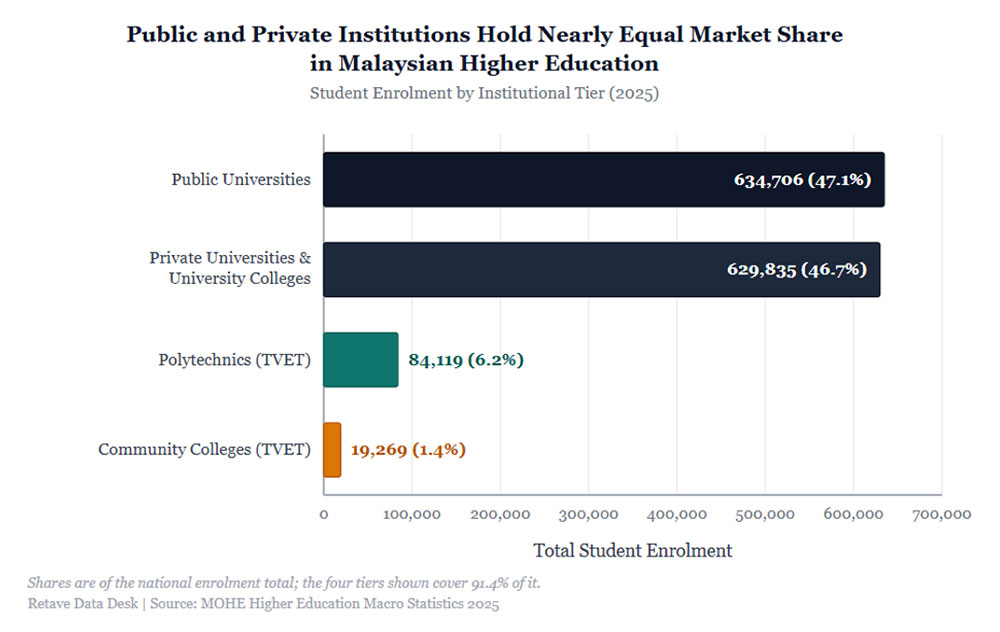
Malaysia’s higher education landscape is divided into two main tiers of providers. On the public side, there are 20 public universities (Universiti Awam), enrolling 634,706 students, and they are divided by the Ministry of Higher Education (MOHE) into Research, Focused, and Comprehensive categories. On the private side sit 141 private universities and university colleges registered with the Malaysian Qualifications Agency (MQA) — including six branch campuses of foreign institutions — enrolling a nearly matching 629,835 students. Beneath the university tier, 36 polytechnics enrol 84,119 students, and more than 100 community colleges enrol a further 19,269, both administered through MOHE’s TVET-facing arm, alongside several hundred smaller private colleges without independent degree-awarding power.
In 2025 alone, the system took in 496,002 new students. It produced 332,871 graduates — an annual throughput scale that places Malaysia among the more institutionally dense higher education systems in the region relative to its population.
Who’s Studying, and What They’re Studying
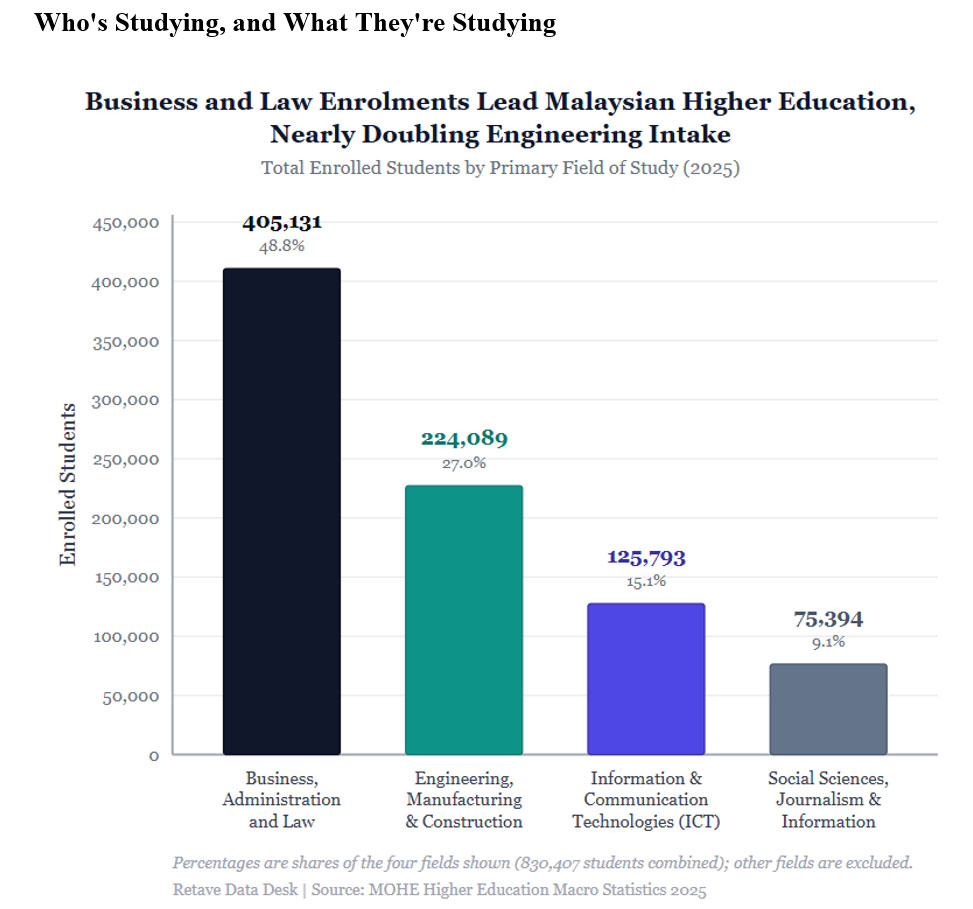
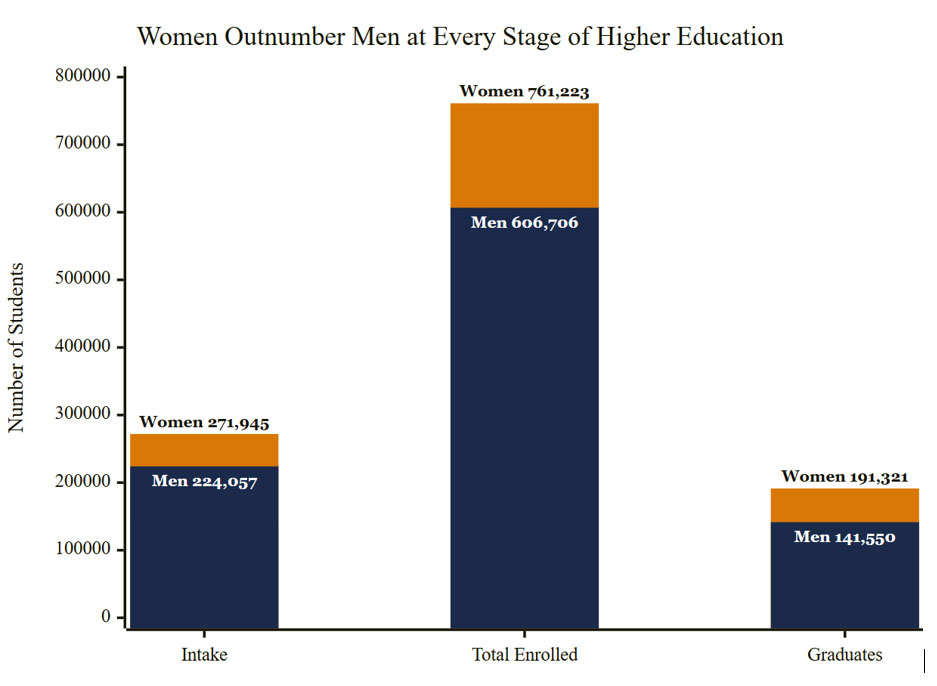
Women make up the clear majority of Malaysia’s student body: 761,223 female students against 606,706 male students, a gap that holds at intake (271,945 female versus 224,057 male) and widens slightly by graduation (191,321 female graduates against 141,550 male graduates). By field of study, Business, Administration, and Law is by far the largest category at 405,131 students, followed by Engineering, Manufacturing, and Construction (224,089), Information and Communication Technologies (125,793), and Social Sciences, Journalism, and Information (75,394).
International enrolment reached 159,138 students in 2025, with private institutions hosting the majority (102,573, or 64.5%) compared with 56,565 at public universities. China is by far the largest single source market, accounting for 62,187 students — 39.1% of the entire international cohort — followed by Indonesia and Bangladesh.
The People Doing the Teaching
Malaysia’s higher education workforce numbers 74,047 academic staff, split almost evenly between public institutions (32,042) and private ones (32,081). Of these, 29,213 hold PhDs and 29,588 hold master’s degrees. Within the public university system alone, there are 2,084 full professors and 5,730 associate professors — a base substantial enough to support serious postgraduate supervision and research activity, not just undergraduate teaching.
Who Regulates What
Two agencies anchor the system’s quality assurance. The Malaysian Qualifications Agency (MQA), established under the Malaysian Qualifications Agency Act 2007, accredits academic diplomas, degrees, and postgraduate qualifications across both public and private institutions and maintains the national Malaysian Qualifications Framework (MQF). This reference structure determines how a qualification from one institution or programme type is recognised elsewhere in the system. TVET-track skills certificates, by contrast, fall under a separate accreditation body, a distinction this section covers in more detail in its TVET coverage.
What the Government Is Currently Spending
Budget 2026, tabled in the Dewan Rakyat in October 2025, allocated RM18.60 billion to the higher education sector — RM14.68 billion for operating expenditure and RM3.91 billion for development spending — a 2.76% increase on the RM18.09 billion allocated in 2025. MOHE has tied the increase to several stated priorities: improving graduate marketability, strengthening research, development, and innovation, expanding TVET, and widening access to quality higher education alongside student welfare.
Several specific measures accompanied the headline figure. More than RM446 million was allocated for student welfare initiatives, including the Ikhtiar Dapur MADANI food-support programme, the MySiswa Job On Campus scheme, and the upkeep of higher education institutions’ infrastructure. A further RM6 billion was allocated toward Bumiputera education priorities, channelled through Majlis Amanah Rakyat (MARA), Yayasan Peneraju, and Universiti Teknologi MARA (UiTM). To create more places for high-performing students, including STPM graduates, the government added 1,500 undergraduate degree places across the country’s five Research Universities, spread across ten fields, including law, accounting, economics, Islamic finance, artificial intelligence, and languages. On the medical and research side, the government approved two public-private partnerships — a Health Technopolis at Universiti Kebangsaan Malaysia and a Health Metropolis project at Universiti Malaya.
Student financing continues to be administered primarily through the National Higher Education Fund Corporation (Perbadanan Tabung Pendidikan Tinggi Nasional, PTPTN), established in 1997 and placed under MOHE, which remains the main study-loan provider for Malaysian students pursuing tertiary education.
Where This Leaves the System
On the whole, the current picture of Malaysian Education is one of a large, structurally balanced system — public and private provision roughly matched in scale, a workforce built for research as well as teaching, and a regulatory framework centred on MQA’s qualification structure — that is currently receiving its largest funding increase in the current budget cycle. That’s the starting point against which Malaysia’s new ten-year higher education blueprint was written, and it is where we will continue to explore in depth next.
Further Reading
- Malaysia’s Higher Education, Mapped: Access, Equity and Research Output
- What Does It Take to Build a Nation-Builder? Inside Malaysia’s 2026-2035 Higher Education Blueprint.
- Inside Malaysia’s graduate tracer study: what the 92.3% employment rate counts, and where pay comes in
Sources directly cited in the article
- MOHE, Higher Education Macro Statistics 2025 — Direct PDF: https://www.mohe.gov.my/muat-turun/statistik/2025-1-1/1851-bab-1-makro-2025-pdf/file
- Malaysian Qualifications Agency (MQA), Register of private universities and university colleges — mohe.gov.my / mqa.gov.my.
- Ministry of Higher Education Malaysia (MOHE), Siaran Media: Belanjawan 2026 — RM18.60 Bilion Pacu Pendidikan Tinggi Negara, mohe.gov.my, 11 October 2025.
- BERNAMA, Belanjawan 2026: Peruntukan KPT Perkukuh Ekosistem Pendidikan Tinggi Negara — official state news agency report of MOHE’s budget statement.
- Perbadanan Tabung Pendidikan Tinggi Nasional (PTPTN) — official corporate background, ptptn.gov.my.