

By: Retave’s Education Desk Editor
Numbers tell part of the Higher Education Blueprint story; the mission statements don’t. Here’s where Malaysia’s system actually stood as MOHE closed the books on the outgoing 2015–2025 blueprint, and what’s on the scoreboard for the next ten years.
Access: mostly on track, one metric beaten outright
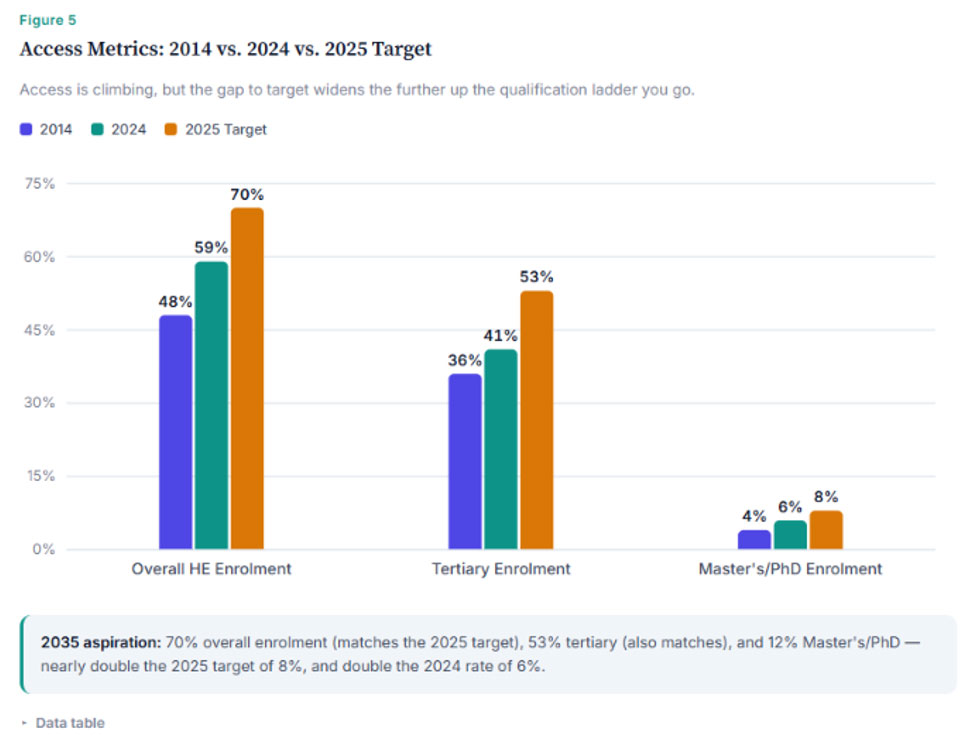
Overall, higher education enrolment climbed from 48% in 2014 to 59% in 2024, a decade of growth that still falls short of the 70% target set for 2025. Tertiary enrolment moved in a similar direction, from 36% to 41%, against a 53% goal, while enrolment at the Master’s and PhD levels rose from 4% to 6%, against an 8% target. The one number that actually cleared its target was raw capacity: the system added 1.5 million new places between 2014 and 2024, well past the 1.1 million originally planned. The 2035 aspiration goes further still, aiming for 70% overall enrolment, 53% at the tertiary level, and a postgraduate rate of 12%, double the rate the system sits at today.
A footnote worth keeping in mind when reading those numbers: “higher education” and “tertiary education” aren’t the same measure in MOHE’s data. Higher education enrolment covers everything from pre-university and matriculation through to postgraduate study; tertiary enrolment is the narrower band starting from Year 2 diploma level upward. The gap between the two figures reflects that broader base, not a data error.
Quality: employability up sharply, international enrolment lagging
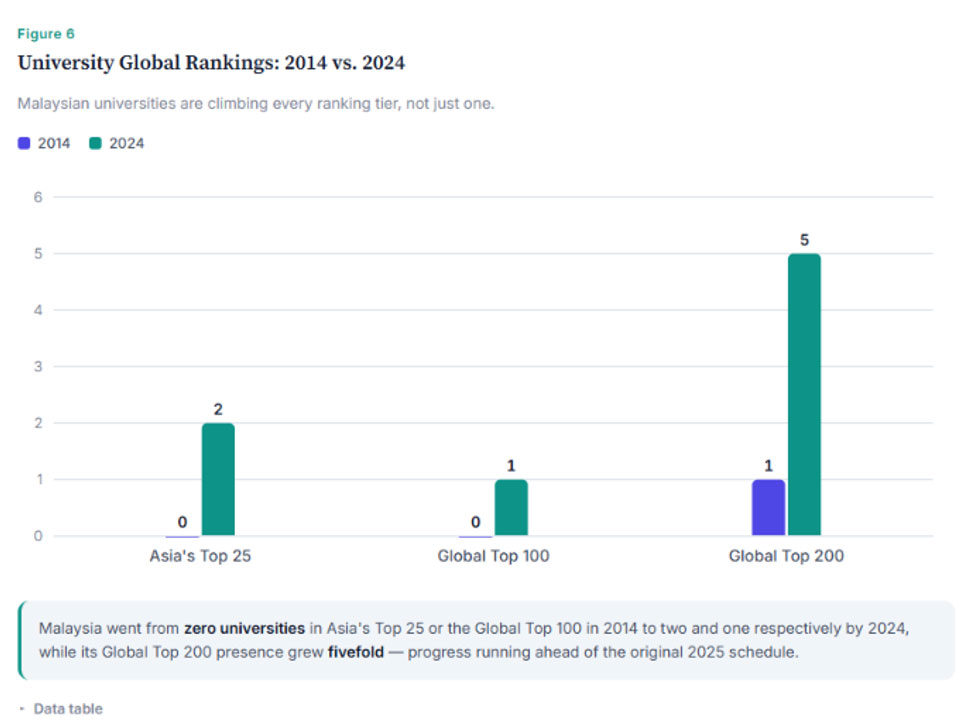
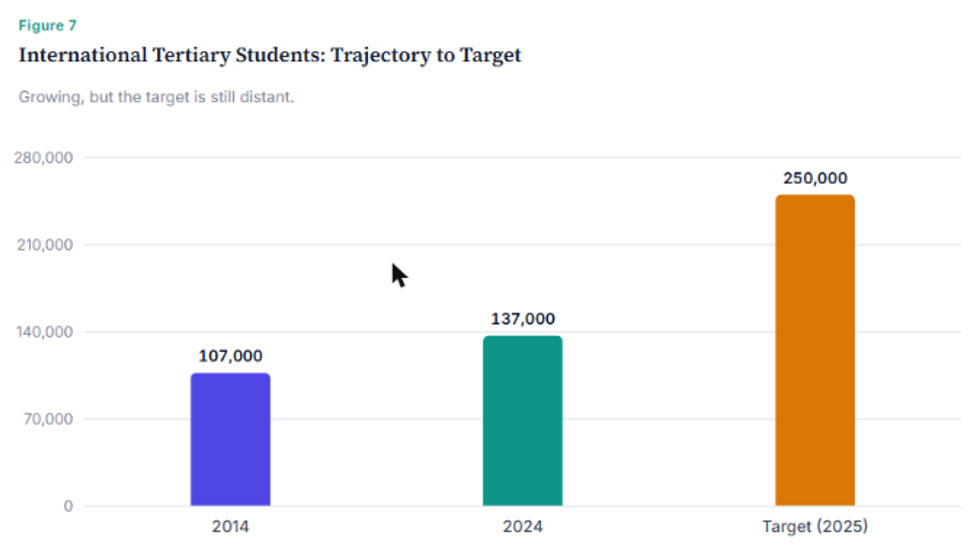
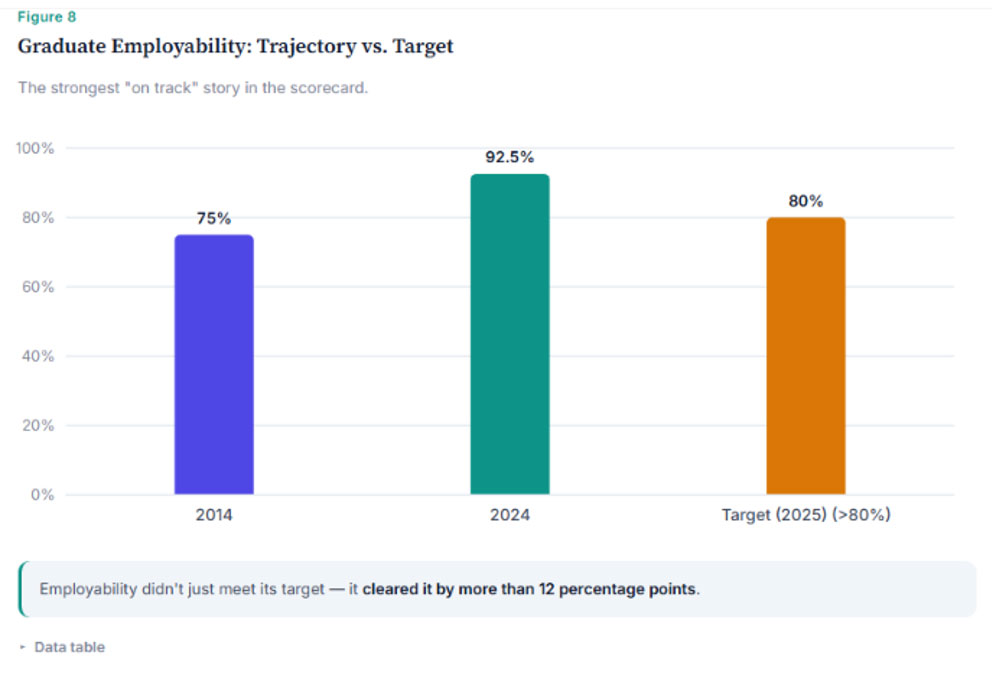
In terms of quality, the movement is more pronounced. Graduate employability rose from 75% in 2014 to 92.5% in 2024, comfortably exceeding the more-than-80% target set by the blueprint. International tertiary enrolment grew too, from 107,000 to 137,000 students, though that’s still well short of the 250,000 target on the books. Rankings shifted the most visibly: Malaysia went from zero universities in Asia’s Top 25 to two, Universiti Malaya at 12th and Universiti Putra Malaysia at 20th, and from zero in the Global Top 100 to one, Universiti Malaya, now sitting at 60th in the QS World University Rankings. The country also went from one university in the Global Top 200 to five, ahead of the original 2025 schedule. On the 2024 Global Education Index, Malaysia landed 14th out of the 25 countries assessed.
Equity: real progress, real gaps still visible
The equity numbers show genuine movement alongside gaps that haven’t closed. Around 68% of B40, or low-income, learners are now enrolled in higher learning institutions. Orang Asli enrolment grew from 480 students in 2015 to 1,204, though that’s still only 0.04% of the total nationwide enrolment. Students with disabilities number 5,641, about 0.18% of the total. And on the Patriotism and National Unity Index, a self-assessment measure, the system scored 90%.
Research: the sharpest growth curve in the document
Research is where the numbers move fastest. Between 2015 and 2022, publications increased by 1.7 times, and citations roughly doubled. Five designated Research Universities accounted for 60% of the country’s total publications on their own. Intellectual property filings grew at 1% a year, and those same Research Universities generated RM3.73 billion in revenue between 2016 and 2022, acting as solutions providers to industry, government agencies, and NGOs.
Where the system is trying to go
The blueprint frames its direction as nine shifts in orientation, moving the system from where it’s been toward where MOHE wants it by 2035:
- Structured education, formal learners → unbundled, lifelong and life-wide learning
- Industry-ready job seekers → job seekers and job creators
- Values-based, output-driven talent → values-internalised, humanity-centric talent
- Process-driven decision-making → intrapreneurial, systems-thinking leadership
- A differentiated system → a harmonised, collaborative ecosystem
- Technology literacy → advanced TVET and STEAM-enabled competencies
- Centralised funding → sustainable, diversified funding
- A regional education hub → a global education hub
- Sustainability as an initiative → leadership in planetary health
Ten strategic shifts carry that direction out: humanity-centric learners, purpose-driven talent, advanced TVET, financial sustainability, agile governance, responsible research and commercialisation, global prominence, flexible and lifelong learning, planetary health, and responsive delivery, each phased across three implementation waves running to 2035.
One figure runs counter to the growth story elsewhere in the data: government spending per student in public institutions has actually fallen, from RM21,000 in 2014 to RM19,000 now, a compound annual decline of about 1%. MOHE frames this as deliberate cost discipline rather than a funding shortfall.
Further Reading
- Malaysia’s Higher Education, By the Numbers: It’s quest to become a Global Education Hub
- What Does It Take to Build a Nation-Builder? Inside Malaysia’s 2026-2035 Higher Education Blueprint.
- One in three, and two in three under 25: what DOSM’s latest numbers say about skill-related underemployment
Source: Malaysia Higher Education Blueprint 2026–2035, Executive Summary. Ministry of Higher Education (MOHE), Malaysia.