
By: Retave’s Research Desk Editor
Walk into a lab at Universiti Malaya or Universiti Sains Malaysia, and you’re standing in one of five buildings that carry an outsized share of the country’s research weight. Malaysia doesn’t spread its research ambitions evenly across all 20 public universities. It concentrates them. And if you’re trying to understand where the country’s science, innovation, and postgraduate output actually comes from, that concentration is the place to start.
The Five Universities shouldering the burden
Universiti Malaya (UM), Universiti Kebangsaan Malaysia (UKM), Universiti Sains Malaysia (USM), Universiti Putra Malaysia (UPM), and Universiti Teknologi Malaysia (UTM) hold Malaysia’s Research University designation. USM carries an additional Apex University status. These five aren’t just older or bigger than the rest of the public university system — they’re mandated to prioritise research and postgraduate output over broad undergraduate teaching, expected to generate their own income, and structurally set up to lead the country’s knowledge-advancement agenda.
The numbers back up the point that they matter. Across the whole higher education system, 70,349 students were enrolled in PhD programmes in 2025, and 29,213 academic staff across Malaysian institutions now hold doctorates — nearly 40% of the entire academic workforce. That’s a deep bench of research capacity, and the five research universities are where most of it clusters.
Where the Money Actually Comes From
Here’s the honest picture: Malaysia spent RM18.16 billion on research and development in 2022, working out to 1.01% of GDP — up from 0.95% in 2020. Break that down by who’s actually paying for it, and the picture shifts year to year:
- Business enterprises: 51.37% of total R&D spending
- Higher learning institutions: 37.17%
- Government research institutes: 11.40%
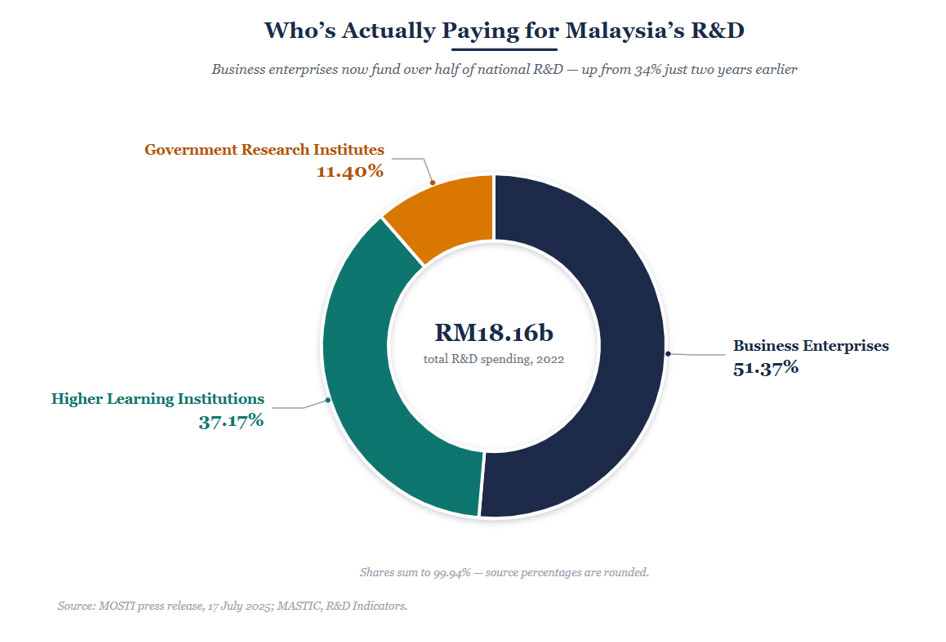
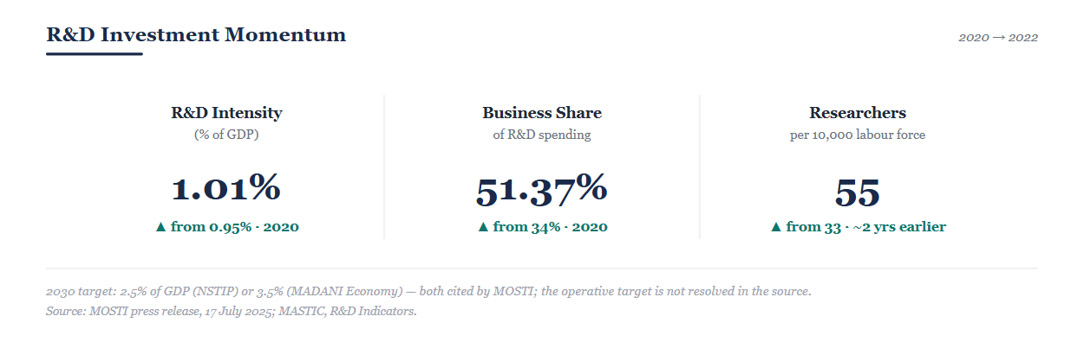
That business share jumped from just 34% in 2020, according to the Ministry of Science, Technology and Innovation (MOSTI). Reads as private industry stepping up as the main driver of the innovation ecosystem. The number of researchers has grown too — 55 per 10,000 in the labour force, up from 33 just two years earlier.
The government’s stated targets are either 2.5% of GDP by 2030 under the National Science, Technology and Innovation Policy, or a more ambitious 3.5% under the MADANI Economy framework — both cited in the same MOSTI release. Either way, there’s ground to cover. As MOSTI Minister, YB Datuk Chang Lih Kang put it: “increasing investment in Research and Development (R&D) is key to transforming Malaysia into a high-income and competitive nation”
How a Researcher Actually Gets Funded
If you’re a lecturer at a Malaysian public university trying to fund your work, everything runs through MOHE’s MyGRANTS portal, managed by the ministry’s Division of Research Excellence. The menu is broader than most people realise:
- FRGS (Fundamental Research Grant Scheme) — the flagship, curiosity-driven fund
- TRGS (Transdisciplinary Research Grant Scheme) and LRGS (Long Term Research Grant Scheme) — trans-disciplinary and long-term research schemes
- PRGS (Prototype Development Research Grant Scheme) — prototype development
- RAGS (Research Acculturation Grant Scheme) — research acculturation for early-career academics
- MyLAB (Malaysia Laboratories for Academia-Business Collaboration) and RACE (Research Acculturation Collaborative Effort) — collaborative schemes linking academia and industry
Data sourced from MOHE, 2025
Sitting alongside these is the Higher Institution Centre of Excellence (HICoE) programme, which has been running since 2008. It doesn’t fund individual projects so much as it crowns entire research centres — rating them against niche research strengths and tying those ratings to research grant incentives, all aimed at pushing centres toward international standing across nine national priority sectors
MOSTI runs a parallel track for anything closer to market. Its newer Structured Commercialisation Accelerator offers up to RM1 million per high-impact project, aimed squarely at getting lab research out the door. The Deputy Minister of MOSTI, YB Dato’ Dr. Mohammad Yusof Apdal, framed the shift bluntly: “Technology R&D is no longer an option, but a national strategic necessity”.
What Budget 2026 Put on the Table
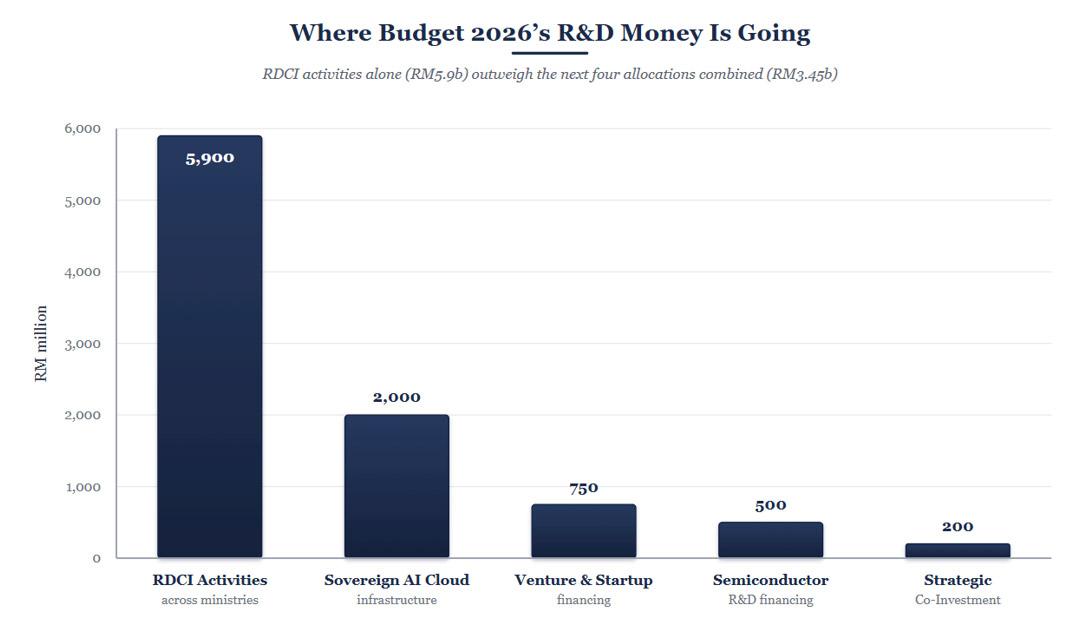
Budget 2026 leaned in. Government allocations included:
- RM5.9 billion for Research, Development, Commercialisation and Innovation (RDCI) activities across ministries.
- RM2 billion for Sovereign AI Cloud infrastructure
- RM750 million for venture and startup financing
- RM200 million for Strategic Co-Investment Funds
- RM500 million in R&D financing for the semiconductor industry, alongside a new National Semiconductor Strategy
Data sourced from MIMOS, 2025
MOSTI’s own ministry allocation for 2026 sits at RM759.68 million for operating expenditure — a 2.8% rise year-on-year — while development spending eased slightly to RM516.21 million from RM536.62 million in 2025.
Is Malaysia Actually Becoming a Research Destination?
This is where the government’s language has gotten noticeably more confident. In the 2025 Global Innovation Index, Malaysia ranked 34th out of 139 economies — behind only Singapore in ASEAN, and the global leader in one specific indicator: graduates in science and engineering.
On rankings, the momentum is real. Malaysia joined the world’s top 40 in the Times Higher Education Asia University Rankings 2026 for the first time, doubling its representation in the top 100. USM and UKM landed among the world’s top seven universities in the Impact Rankings for progress on the UN Sustainable Development Goals — USM ranked fifth globally, UKM seventh. Higher Education Minister YB Datuk Seri Dr. Zambry Abdul Kadir called it proof that “Malaysian universities excel not only in teaching and research, but also in delivering meaningful contributions to society and the global sustainability agenda,” adding that he hoped it would help “place Malaysia as a world-class higher education hub”.
That ambition is showing up in policy moves too — MOHE is currently developing a Malaysia–Indonesia research consortium spanning food security, green energy, aerospace, AI, and semiconductors. MOHE Minister YB Datuk Seri Dr. Zambrys Abdul Kadir has called on universities to think beyond publication counts: “Universities today need to play a greater role in producing innovations that can generate meaningful impact on the economy and society”.
None of this closes the gap with South Korea, Japan, or Singapore overnight — MOSTI itself acknowledges that Malaysia still lags behind those economies in R&D intensity. But between five research universities pulling above their weight, a funding structure that’s finally tilting toward industry, and a government willing to put its ministers’ names on ambitious targets, Malaysia’s research story right now is one of a system still building toward the destination it’s already describing itself as.