By: Retave’s Research Desk Editor
When the call from Stockholm came on 7 October, Professor Emeritus Kenso Soai was at his neighbourhood supermarket. By that evening, one of Japan’s biggest newspapers had printed an extra edition with his name in the headline, and it sold out as office workers picked up copies on their way home.
At a press conference at Tokyo University of Science’s Kagurazaka campus, the 76-year-old professor emeritus kept his thanks simple. He said he was able to reach this point “thanks to the students.”
Professor Soai shares the 2026 Nobel Prize in Chemistry with Professor Emeritus Henri B. Kagan, 95, of Université Paris-Sud in Orsay, France. He’s also the only laureate this year who was born and works in the Asia-Pacific.
The 2026 winners at a glance
The prizes were announced between 5 and 12 October:
- Physiology or Medicine: Karl Deisseroth (United States), Peter Hegemann and Georg Nagel (Germany), for optogenetics
- Physics: Francis Halzen, born in Belgium and based at the University of Wisconsin-Madison, for the IceCube Neutrino Observatory
- Chemistry: Henri B. Kagan (France) and Kenso Soai (Japan)
- Literature: Anne Carson, the Canadian poet and writer
- Peace: Navi Pillay, the South African human rights lawyer and former United Nations High Commissioner for Human Rights, whose family is of Indian Tamil descent
- Economic Sciences: Robert Hall and Michael Woodford (United States), for research showing how central banks and governments can use monetary and fiscal policy to smooth out economic ups and downs
The region also shows up behind the scenes. IceCube, the Antarctic detector behind the physics prize, is run by a collaboration of 58 institutions in 14 countries. Six of them are in the Asia-Pacific: Academia Sinica in Taiwan, Chiba University in Japan, Chung-Ang University and Sungkyunkwan University in South Korea, the University of Adelaide in Australia and the University of Canterbury in New Zealand.
“The coolest experiment in organic chemistry”
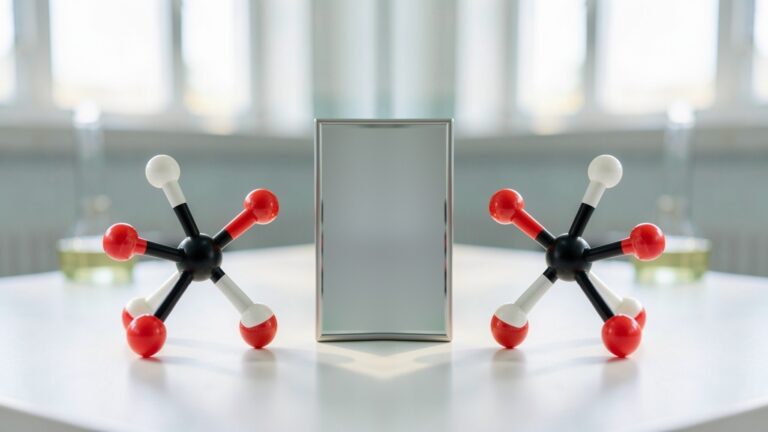
Plenty of molecules come in two forms that are mirror images of each other, like your left and right hands. The two can behave very differently. One form of carvone smells of mint, and its mirror image smells of caraway. In medicine, the right form of a drug can make all the difference.
In the 1980s, Professor Kagan showed that chemists might be able to design reactions that favour one form over the other. Professor Soai took it further. In 1995, his group at Tokyo University of Science reported in Nature the first example of asymmetric autocatalysis, a reaction in which the product is the catalyst for its own formation. Start with a slight excess of one mirror image, and each round builds on it until that form dominates. Chemists call it the Soai reaction.
His university says it may help explain why the molecules that make up living things come mostly in one of their two mirror-image forms, a long-standing question about the origin of life. Professor Peter Somfai of the Nobel Committee for Chemistry called it “probably the coolest experiment in organic chemistry.”
The professor who thanked his students
According to Tokyo University of Science, Professor Soai was born in Hiroshima Prefecture in 1950. He studied at the University of Tokyo’s Faculty of Science, where he earned a Doctor of Science degree. He was a Research Fellow of the Japan Society for the Promotion of Science and a postdoctoral researcher at the University of North Carolina in the United States.
He then became a professor in Tokyo University of Science’s Faculty of Science Division I, where he made the discovery, and he’s now a professor emeritus there.
Three years, four Japanese laureates
Professor Soai extends a streak. Japan has had a laureate in each of the last three years:
- 2024: Nihon Hidankyo, the organisation of atomic bomb survivors, Peace
- 2025: Shimon Sakaguchi of the University of Osaka, Physiology or Medicine, for his work on regulatory T cells
- 2025: Susumu Kitagawa of Kyoto University, Chemistry, for metal-organic frameworks
- 2026: Kenso Soai of Tokyo University of Science, Chemistry
That makes back-to-back chemistry prizes for researchers at Japanese universities. By RETAVE’S count, Professor Soai is the 31st Nobel laureate born in Japan. Part 2 of this series lists every Asia-Pacific-born laureate and explains how we counted.
From a Tokyo lab to your lecture hall
The discovery came out of a university chemistry department in Tokyo, and the laureate’s first public thanks went to his students. The Soai reaction makes a ready-made example for a second-year chirality class: start with a slight excess of one mirror image, and watch the reaction build it up.
On 10 December, Professor Soai and Professor Kagan are due to receive their medals in Stockholm, a long way from the neighbourhood supermarket where the news first reached him. Part 3 of this series turns to Malaysia and to a Penang-born doctor nominated for the prize in 1935.
Further Reading
- 92 Nobel laureates, one region: every Asia-Pacific-born winner from Ronald Ross to Kenso Soai
- Has a Malaysian ever been nominated for a Nobel Prize? From a Penang plague fighter to today’s rising researchers
- Five Universities, RM18 Billion, and Malaysia’s Quiet Bet on Becoming a Research Nation.
Sources
- Al Jazeera. (2026, October 12). Nobel economics prize awarded to Robert Hall and Michael Woodford. https://www.aljazeera.com/news/2026/10/12/nobel-economics-prize-awarded-to-robert-hall-and-michael-%E2%81%A0woodford
- Associated Press. (2026, October 7). Henri B. Kagan and Kenso Soai win Nobel Prize in chemistry [Updated October 8, 2026]. KPBS. https://www.kpbs.org/news/science-technology/2026/10/07/henri-b-kagan-and-kenso-soai-win-nobel-prize-in-chemistry
- Bernama. (2026, October 5). German duo and US scientist win Nobel medicine prize for optogenetics. https://www.bernama.com/tv/news.php?id=2615839
- IceCube Neutrino Observatory. (n.d.). Institutions. Retrieved October 12, 2026, from https://icecube.wisc.edu/collaboration/institutions/
- Johnston, H. (2026, October 6). Francis Halzen wins Nobel Prize in Physics. Physics World. https://physicsworld.com/?p=130829
- Nicholson, E., & Livingstone, E. (2026, October 9). South African human rights lawyer Navi Pillay wins Nobel Peace Prize. NPR, via HPPR. https://www.hppr.org/npr-news/2026-10-09/south-african-human-rights-lawyer-navi-pillay-wins-nobel-peace-prize
- Reuters. (2026, October 8). Canadian poet, writer Anne Carson wins 2026 Nobel Prize in Literature. Khaleej Times. https://www.khaleejtimes.com/world/anne-carson-canadian-poet-writer-2026-nobel-prize-literature
- Science Council of Japan. (2025, October 10). Statement on the award of the 2025 Nobel Prizes to Dr. Shimon Sakaguchi and Dr. Susumu Kitagawa. https://www.scj.go.jp/ja/head/pdf/20251010en.pdf
- Soai, K., Shibata, T., Morioka, H., & Choji, K. (1995). Asymmetric autocatalysis and amplification of enantiomeric excess of a chiral molecule. Nature, 378, 767–768.
- Tokyo University of Science. (2026, October 8). Professor Emeritus Kenso Soai awarded 2026 Nobel Prize in Chemistry. https://www.tus.ac.jp/en/news/archive/20261007_3541.html