
By: Retave’s Research Desk Editor
Before Malaysian Ringgit (MYR) gets spent on Malaysian research, someone has to decide what’s worth funding in the first place. The National Science, Technology and Innovation Policy (NSTIP) 2021–2030 answers that question under Technology Development through Research, Development, Commercialization and Innovation (R&D&C&I), known in the policy as Thrust 2, and it treats priority-setting and money management as two halves of one problem.
Choosing what gets researched
Determination of National Research Priority Areas (Strategy A) sets out why national Research and Development (R&D) priority areas are necessary. Without them, the policy argues, the country risks funding research that doesn’t align with its actual development needs. The idea is to shift the industry from being a user of technology to being a developer of it, and that shift has to start with what gets studied.
Under Initiative A1, those priority areas are meant to be set based on national development planning, existing research strengths, emerging technologies, future scenarios, and the expertise already available in the country, and then reviewed periodically through strategic planning and foresight. The policy calls this review process essential to keep priorities in step with national needs and global economic shifts, since a five-year-old priority list can go stale fast in fields like biotechnology or semiconductors.
Sharing the tools so the money isn’t wasted
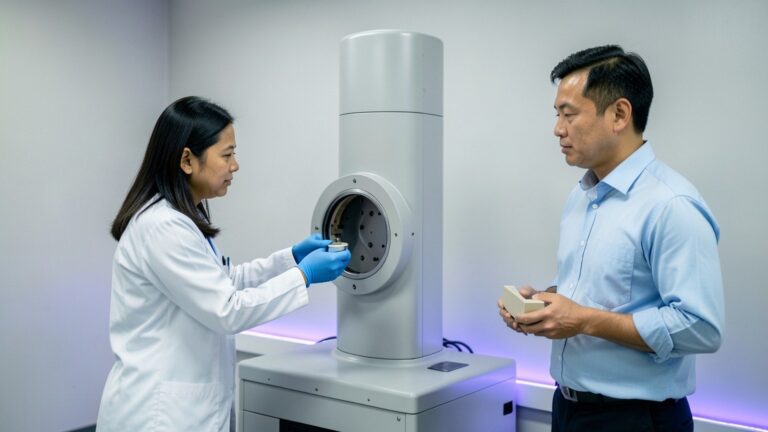
Once priorities are set, the policy still needs researchers to act on them. Enhancing R&D for High Value Outputs, High Impact Outcomes, and New Innovations (Strategy B) calls for stronger fundamental, applied, and experimental development research, with increased investment directed toward work that aligns with the needs of future industries and emerging technologies. That’s the point where NSTIP turns to making sure the investment behind that research actually gets used. Strategy B calls for public research institutes (PRIs) and institutions of higher learning (IHLs) to share facilities, equipment, and expertise, on the reasoning that government money spent on a piece of lab equipment at one university shouldn’t sit idle. At the same time, a researcher elsewhere buys a duplicate. The policy’s answer to that problem, and to a related one around data sharing under Encouraging Open Data Sharing (Strategy D), is a single shared platform: the Malaysia Open Science Platform (MOSP). MOSP is designed to enable the public sector, industry, researchers, and the community to share and use data tied to expertise, resources, and facilities, with the stated goals of avoiding research duplication, strengthening cooperation across the R&D&C&I ecosystem, and making it easier to manage the Science, Technology, and Innovation (STI) system as a whole.
Managing the funds and finding alternatives to them
Improving R&D Fund Management and Alternative Funding Sources (Strategy C) is where the policy becomes specific about fund management. It calls for a national guideline covering R&D fund management, setting out priority areas, research types, evaluation criteria, and monitoring and enforcement mechanisms, framed explicitly around preventing the intransparency and leakage that the policy says can drag down the country’s economic growth. That same guideline is also meant to serve as a monitoring tool for alternative funding sources, which the National Science, Technology, and Innovation Policy actively encourages ministries, agencies, Institutions of higher learning, and PRIs to pursue rather than relying solely on government allocations. The policy names industry funding, donations, crowdfunding, and international research grants as legitimate routes to reduce that dependency.
Put together, these strategies form the machinery behind the National Science, Technology and Innovation Policy’s bigger ambitions: a system for deciding what Malaysia researches, a shared platform for using what’s already been built, and a set of rules for keeping the money honest. None of it is glamorous. A national guideline on fund disbursement doesn’t get a press conference the way a new lab does. But it’s what determines whether a research priority survives past the announcement stage, and whether the next researcher who needs equipment has to buy their own or can book time on someone else’s.
Further Reading
- Malaysia’s Innovation Policy and the Role of Universities in National R&D
- Five Universities, RM18 Billion, and Malaysia’s Quiet Bet on Becoming a Research Nation.
- Budget 2027 puts RM6 billion into research, and opens a road from the lab to the market
Sources
Ministry of Science, Technology, and Innovation. (2021). National Science, Technology and Innovation Policy 2021–2030. https://www.mosti.gov.my/wp-content/uploads/2022/03/National-Science-Technology-and-Innovation-Policy-2021-2030.pdf