
By: Retave’s Technology Desk Editor
In May 2024, Prime Minister Datuk Seri Anwar Ibrahim launched the National Semiconductor Strategy. Its talent goal speaks directly to the country’s engineering faculties: 60,000 high-skilled Malaysian engineers and workers for the chip industry by 2030.,
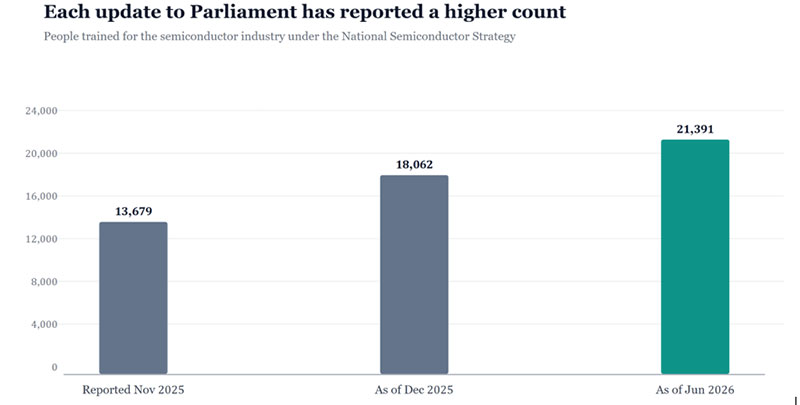
Two years on, the count is climbing steadily. By June 2026, 21,391 people had been trained, according to a written parliamentary reply from the Ministry of Investment, Trade and Industry (MITI). It puts the drive more than a third of the way to the 2030 goal.
The goal: 60,000 by 2030
Malaysia has long been one of the Asia-Pacific’s big names in chip assembly, testing, and packaging, the back-end stages of making a semiconductor. The strategy aims to move the country further up the value chain into chip design, advanced packaging, and wafer fabrication.
Talent is at the centre of that plan. Alongside the 60,000 target, Datuk Seri Anwar announced RM25 billion in fiscal support for the strategy.
Three replies to Parliament
The count has been reported to the Dewan Rakyat, Parliament’s lower house, three times, and each figure is higher than the last.
- On 17 November 2025, Liew Chin Tong, then Deputy Investment, Trade and Industry Minister, said 13,679 engineers and skilled technical personnel had been trained, certified, and absorbed into the industry.
- On 16 July 2026, Deputy Investment, Trade and Industry Minister Sim Tze Tzin said 18,062 local talents had been trained as of December 2025. The training ran through the Engineering Talent for Semiconductor Industry (ETSI) programme.
- In early October 2026, MITI’s written reply put the figure at 21,391 as of June 2026, trained through programmes run by higher education institutions and technical training providers.
Four universities in the mix
In his November reply, Mr Liew named three universities in the training effort: Universiti Sains Malaysia (USM), Universiti Malaya (UM), and Universiti Teknologi Malaysia (UTM), as well as industry skills centres.
He listed four segments the training covers: integrated circuit (IC) design, advanced packaging, wafer fabrication, and research and development. He also described how the partnerships work in practice: industry-built curricula, high-tech laboratories, industrial training attachments for students, and joint applied research.
At Universiti Teknologi MARA (UiTM) in Penang, there are industry engineers in the lecture hall. In December 2025, under the ETSI Finishing School Programme run with the Collaborative Research in Engineering, Science and Technology (CREST) centre, a principal engineer from chip-design firm Oppstar Technology and a vice-president of semiconductor firm Inari Technology took final-year electrical and electronic engineering students through the industry, from system-on-chip design to assembly and testing.
More places in the pipeline
Mr Liew also pointed to two Budget 2026 initiatives. Khazanah Nasional, Malaysia’s sovereign wealth fund, set aside RM200 million for its K-Youth and TVET (technical and vocational education and training) programme, which offers on-the-job training to 11,000 young people without degrees. And an IC Design Flagship programme carries RM340 million to develop 2,500 people in chip design.
MITI’s October reply adds the industry side. The ministry’s 10+100 local champions programme aims to grow a group of Malaysian semiconductor companies into billion-ringgit businesses. Five local firms have come together in the Malaysia Advanced Packaging Consortium, and two programmes, MyChipStart and SemiconStart, support local chip design firms.
The reply sums up the direction in a short phrase: from “Made in Malaysia” to “Made by Malaysia.”
The hub Malaysia is building
Investment is arriving alongside the talent. Deputy Minister Sim reported RM91.9 billion in approved semiconductor investment between January 2024 and March 2026. In Mr Liew’s words, the aim is for Malaysia to become a “regional hub for global-standard semiconductor human capital development.”
Further Reading
- Becoming technology creators: what NIMP 2030’s ‘Tech Up’ mission means for Malaysia’s campuses
- Aerospace, chips, and pharma: where TVET graduates fit in three NIMP 2030 sectors
- Malaysia’s New Apprenticeship Economy: From General STI Talent to AI-Specific Pathways
Sources
- Bernama. (2026, October 6). MITI: 21,391 semiconductor talents trained as of June 2026. https://www.bernamabiz.com/news.php?id=2616354
- Malay Mail. (2024, May 28). PM Anwar: Malaysia to train, upskill 60,000 engineers, allocate RM25b in fiscal support for National Semiconductor Strategy. https://www.malaymail.com/news/malaysia/2024/05/28/pm-anwar-malaysia-to-train-upskill-60000-engineers-allocate-rm25b-in-fiscal-support-for-national-semiconductor-strategy/136918
- New Straits Times. (2025, November 17). Malaysia is confident of meeting the 60,000 skilled semiconductor workers target. https://www.nst.com.my/news/nation/2025/11/1316918/malaysia-confident-meeting-60000-skilled-semiconductor-workers-target
- RTM Berita. (2026, July 16). Lebih 18,000 bakat tempatan dilatih sokong industri semikonduktor, AI. https://berita.rtm.gov.my/nasional/senarai-berita-nasional/senarai-artikel/lebih-18000-bakat-tempatan-dilatih-sokong-industri-semikonduktor-ai/
- The Star. (2026, October 8). Chip talent drive one-third of the way to 2030 goal. https://www.thestar.com.my/news/nation/2026/10/08/chip-talent-drive-one-third-of-the-way-to-2030-goal
- Universiti Teknologi MARA. (2025, December 25). UiTM Pulau Pinang empowers future engineers through ETSI semiconductor industry lecture series. UiTM NewsHub. https://ir.uitm.edu.my/id/eprint/139084/