By: Retave’s Education Desk Editor
Better lecture halls, better hostel rooms and new equipment. Those were the three things Prime Minister Datuk Seri Anwar Ibrahim named on 9 October, when he tabled Budget 2027 in the Dewan Rakyat, Malaysia’s lower house of Parliament. He set aside RM800 million to repair and upgrade public universities. It’s a focused list, and it tells you where this year’s higher education money is pointed: at the buildings students live and learn in, and at what it costs them to be there.
Behind that short list lies a larger budget for the Ministry of Higher Education and a series of measures that put money back in students’ pockets.
An extra RM500 million for MOHE
Funding for the Ministry of Higher Education (MOHE) climbs to RM19.1 billion for 2027, up from RM18.6 billion this year. Higher Education Minister Datuk Seri Dr Zambry Abd Kadir put the increase at 2.7 per cent when he spoke to reporters in Lumut on 11 October.
The Federal Expenditure Estimates 2027, the line-by-line book behind the speech, splits that total in two. Operating spending, which covers salaries, running costs and grants to institutions, rises to RM15.13 billion from RM14.68 billion. Development spending for buildings, equipment, and multi-year projects rises to RM3.96 billion from RM3.91 billion.
UiTM leads the list
Among individual universities, Universiti Teknologi MARA (UiTM) has the biggest operating line, at RM2.33 billion. Universiti Sains Malaysia (USM), Universiti Malaya (UM), Universiti Kebangsaan Malaysia (UKM) and Universiti Putra Malaysia (UPM) each sit between RM647 million and RM681 million.
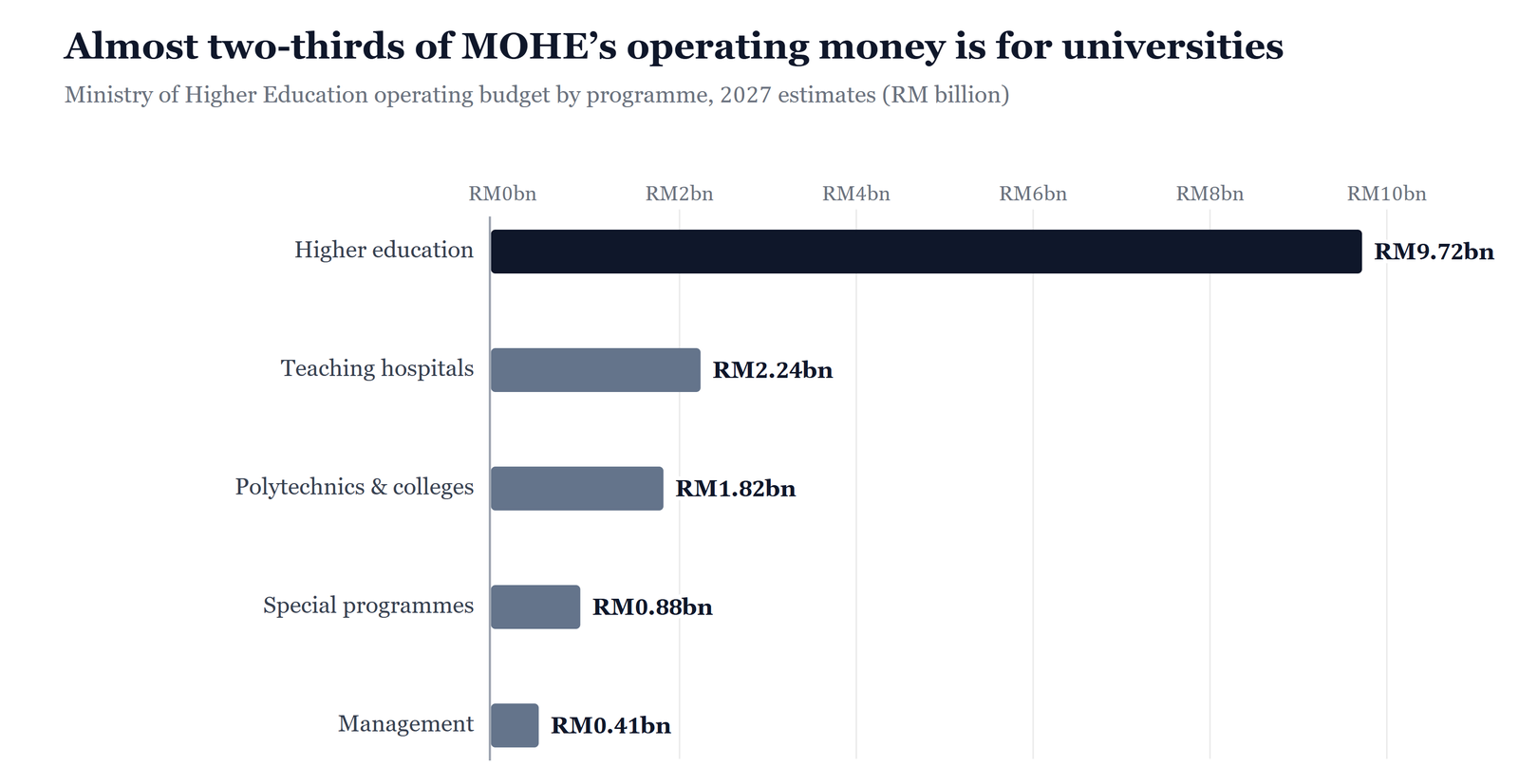
Those university lines sit within MOHE’s higher education programme, which also funds the Department of Higher Education and totals RM9.72 billion, up from RM9.47 billion. University teaching hospitals get RM2.24 billion, up from RM2.17 billion, and polytechnics and community colleges get RM1.82 billion, up from RM1.74 billion. Special programmes take RM877 million, and management, which includes the Malaysian Qualifications Agency (MQA) and the Higher Education Leadership Academy (AKEPT), RM414 million.
New beds and better lecture halls
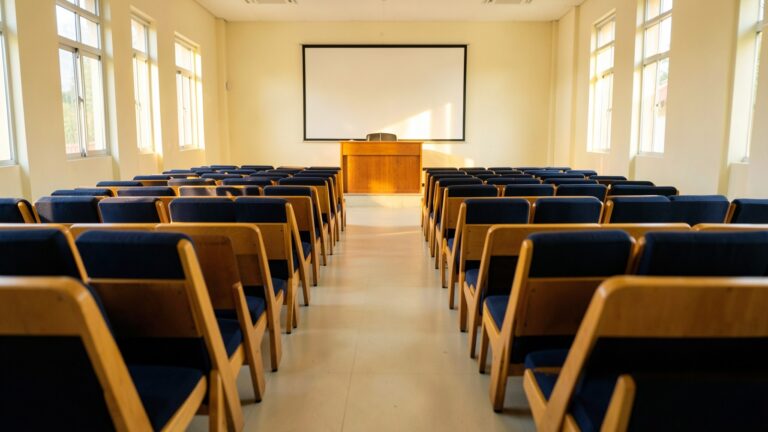
According to the speech, the RM800 million will “upgrade infrastructure such as lecture halls and student accommodation, as well as replace obsolete equipment.” How it’s shared between campuses is for MOHE to set out.
Housing has two more commitments. Phase 1 of a new Universiti Malaya student residence, for 10,000 students, is scheduled for completion in 2031. And the Retirement Fund (Incorporated), known as KWAP, will invest RM750 million in a Vista Kampus project to build student residences at six selected universities. In a statement on 10 October, MOHE said the housing plans would also help students with accommodation and rental costs.
Universities see the same benefit. Prof Dr Suriyani Muhamad, vice-chancellor of Universiti Malaysia Terengganu (UMT), said in a statement on 10 October that “the provision of comfortable and affordable accommodation is important to ensure that students enjoy a better campus life without being overly burdened by high rental costs.”
There’s a new reason to give, too. Contributions to public universities from the public, alumni and companies will qualify for an income tax deduction of up to 10 per cent of aggregate income.
An RM5 meal and a cheaper flight home
For students and parents, these are the lines to check:
- If you borrowed from the National Higher Education Fund Corporation (PTPTN) and earn up to RM2,500 a month, you can defer your repayments for 2027. Those earning RM2,500 to RM3,000 pay a minimum of RM50 a month, and borrowers with no arrears who repay regularly get a 10 per cent discount. The government says more than 400,000 borrowers benefit.
- Employers who repay PTPTN loans on behalf of their staff get a tax deduction for repayments made from 1 January 2027 to 31 December 2028.
- FlySiswa flight assistance rises from RM400 to RM500, an extra RM100 towards the flight home for each of more than 60,000 students at public universities.
- Dapur Siswa Madani, the campus meal programme, expands to polytechnics and teacher education institutes with RM20 million, including a meal priced at RM5.
- Public Service Department (JPA) sponsorship offers for Sabah- and Sarawak-born students double, so 4,200 young people from the two states can go to university each year.
- Form Six students get a yearly RM2,500 living allowance, the same amount that matriculation students receive, for about 90,000 students.
The Form Six allowance also fits MOHE’s own plans: Datuk Seri Dr Zambry told the Dewan Rakyat in February that matriculation would move under his ministry, with full implementation planned for 2027 once the relevant laws are amended.
No ringgit is needed for a reform to be made.
One announcement needed no ringgit at all. The speech puts it plainly: “With immediate effect, all disciplinary proceedings at public universities relating to freedom of expression, the expression of views, public criticism and peaceful assembly are hereby discontinued.”
MOHE is also preparing a legal framework to replace the Universities and University Colleges Act 1971 (UUCA, known in Malay as AUKU). The speech says it will cover university autonomy, academic freedom, and students’ rights. On 11 October, Datuk Seri Dr Zambry called it the One Higher Education Act (OHEA) and said the ministry was studying the proposal from every angle before announcing when it would take effect.
RM2,500 to get graduates off the ground
The speech also sets a direction for graduate pay. The government will reform its wage framework, “beginning with a minimum wage of 2,500 ringgit a month for semi-skilled workers and graduates.” The start date and the details, from job categories to enforcement, are the next pieces to be set out.
For students arriving on campus in 2027, the RM800 million may be the line they notice first: a renovated lecture hall, a refurbished hostel room, a lab bench with new equipment.
Further Reading
- TVET gets RM8 billion and three million training places in Budget 2027
- Budget 2027 puts RM6 billion into research, and opens a road from the lab to the market
- Budget 2027’s campus wins are on their way through Parliament
Sources
- Bernama. (2026a, February 25). MOHE implements ‘single window, single offer’ system to avoid students receiving multiple offers. https://bernama.com/en/news.php?id=2527522
- Bernama. (2026b, October 6). Second reading of Supply Bill 2027 this Friday at 3.30 pm. https://www.bernama.com/tv/news.php?id=2616079
- Bernama. (2026c, October 9). Budget 2027: Government raises minimum wage to RM2,000 – PM Anwar. https://bernama.com/en/general/news.php?id=2617639
- Bernama. (2026d, October 10). Budget 2027 allocation strengthen higher education, drive innovation – MOHE. https://www.bernama.com/en/general/news.php?id=2618229
- Bernama. (2026e, October 10). Budget 2027 strengthens university students’ welfare – UMT. https://www.bernama.com/en/general/news.php?id=2618193
- Bernama. (2026f, October 11). Budget 2027: RM800 mln allocation reflects govt commitment to student welfare – Zambry. https://www.bernama.com/en/general/news.php?id=2618567
- Ministry of Finance Malaysia. (2026a). Budget 2027 speech [English translation of the speech by Prime Minister and Finance Minister Anwar Ibrahim, tabled in the Dewan Rakyat on 9 October 2026]. https://belanjawan.mof.gov.my/pdf/belanjawan2027/ucapan/bs27.pdf
- Ministry of Finance Malaysia. (2026b). Anggaran perbelanjaan persekutuan 2027: Kementerian Pendidikan Tinggi (B.64 dan P.64) [Federal expenditure estimates 2027: Ministry of Higher Education]. https://belanjawan.mof.gov.my/pdf/belanjawan2027/perbelanjaan/BP.64.pdf