

By: Retave’s Technology Desk Editor
Eight editions of Malaysia’s Critical Occupations List, and two hands-on tech jobs appear in every one: Software Developers and Information Technology System Administrators.
The list, known as MyCOL, is published by TalentCorp, an agency under Malaysia’s Ministry of Human Resources (KESUMA). Its eighth edition, MyCOL 2024/2025, names 66 occupations across 18 sectors of the economy. Nine of the 66 have been on the list since it began in 2015, and three of those nine are digital roles.
A list built with employers
TalentCorp calls MyCOL a national policy instrument. Its job is to identify priority occupations facing skills shortages, using labour-market data and direct input from employers. In this edition, a record 77% of the employers surveyed were small, medium, or micro enterprises.
The nine long-running occupations, TalentCorp says, reflect “enduring shortages in STEM [science, technology, engineering and mathematics], digital, and managerial talent.” Information and Communications Technology Managers complete the digital trio. The other six are Finance Managers, Business Services Managers, Industrial and Production Engineers, Mechanical Engineers, Manufacturing Professionals, and Mechanical Engineering Technicians.
For a student weighing up a computing course, the list offers a decade of steady signals from employers, through a pandemic and several economic swings.
Inside the software developer profile
MyCOL 2024/2025 includes detailed profiles for selected occupations, and Software Developers is one of them. Manufacturing tops its list of sectors hiring software developers, ahead of transportation and storage, and information and communication. For the years ahead, employers expect skills in AI and big data, technological literacy, and analytical thinking. Day-to-day, they look for digital engagement, initiative, and numeracy, along with know-how in digital technologies and electronics, operating procedures, and communication and collaboration.
Software work in Malaysia reaches well beyond tech companies, into factories, ports, and logistics hubs.
Employers’ top three ways of meeting demand all help graduates and career switchers: expanding local recruitment, opening the door to applicants with fewer formal qualifications, and raising wages.
The economy behind the demand
The Department of Statistics Malaysia (DOSM) released its ICT Satellite Account 2025 on 15 October 2026. It measures the information and communication technology (ICT) economy: the ICT industry itself, plus e-commerce carried out by businesses in other industries.
- The ICT economy was worth RM476.8 billion, or 23.5% of gross domestic product (GDP), after growing 5.6% in the year.
- The ICT industry on its own added RM288.1 billion.
- ICT employment reached 1.27 million people, roughly one in every 13 jobs in Malaysia.
- ICT exports rose 14.8% to RM513.6 billion.
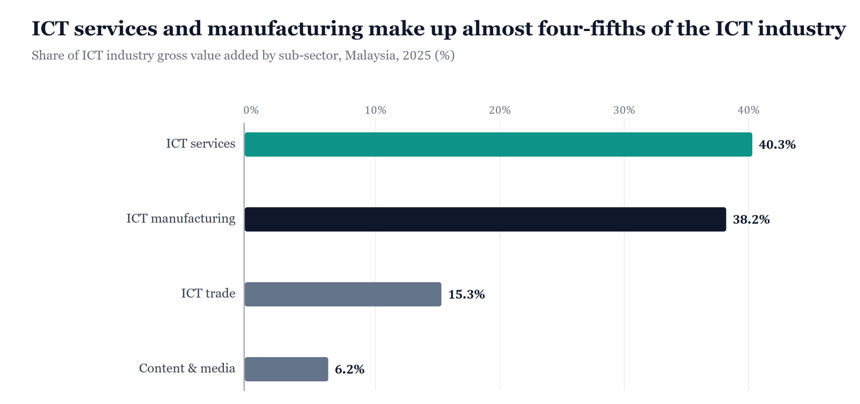
ICT services, where much of the software and systems work is performed, are the largest of the four sub-sectors and grew by 7.6%. ICT manufacturing, home to Malaysia’s electronics and chip plants, is close behind, growing 6.4%. Between them, the two account for almost four-fifths of the industry.
The wider digital family
By RETAVE’S count, using the nine groups from our TVET Desk’s guide, “The 66-occupation list, decoded”, MyCOL 2024/2025 names nine digital and information technology professions. Alongside the two long-standing roles are Computer Systems Analysts, Application Programmers, Database Designers and Administrators, Computer Network Professionals, Data Professionals, and Cyber Security Professionals, as well as a broader group of other software and application developers and analysts.
Data Professionals and Cyber Security Professionals point to where the field is heading. Our companion piece, “Cybersecurity’s seat on Malaysia’s critical jobs list, and the students it’s reaching,” takes a closer look at that side of the list.
From policy plans to visas
MyCOL is built to be used. TalentCorp says it informs the 13th Malaysia Plan, the New Industrial Master Plan 2030 (NIMP 2030), the National TVET Policy 2030, and the National Energy Transition Roadmap. It also shapes academic programme development and the design of upskilling routes and technical and vocational education and training (TVET) pathways.
For readers across the Asia-Pacific, one more use stands out. MyCOL feeds into immigration approvals, including the Returning Expert Programme, which helps Malaysian professionals abroad come home, and the Residence Pass–Talent for skilled professionals from overseas.
A decade of demand, and a growing field
Ten years on from the first list, the two roles sit inside an ICT economy worth almost a quarter of Malaysia’s GDP. For students choosing a computing course this year, the field has plenty of room to grow.
Further Reading
- The 66-occupation list, decoded: what the Malaysia Critical Occupations List (MyCOL) 2024/2025 names, group by group
- Cybersecurity’s seat on Malaysia’s critical jobs list, and the students it’s reaching
- Malaysia’s New Apprenticeship Economy: From General STI Talent to AI-Specific Pathways
Sources
- Department of Statistics Malaysia. (2026, October 15). Information and communication technology satellite account 2025.
https://www.dosm.gov.my/portal-main/release-content/information-and-communication-technology-satellite-account-2025 - TalentCorp Malaysia. (n.d.-a). Malaysia Critical Occupations List (MyCOL).
https://www.talentcorp.com.my/our-initiatives/data-research/mycol/ - TalentCorp Malaysia. (n.d.-b). MyMahir Malaysia Critical Occupations List (MyCOL) 2024/2025 [Brochure]. https://www.talentcorp.com.my/images/uploads/publication/205/MyMahir-MyCOL-20242025-Brochure-1773377416.pdf